Plant the Trees Podcast:
Chestnuts and Food For the Future
Summary
Russell Wallack, founder of Breadtree, joins us to talk chestnuts and perennial pantry staples.
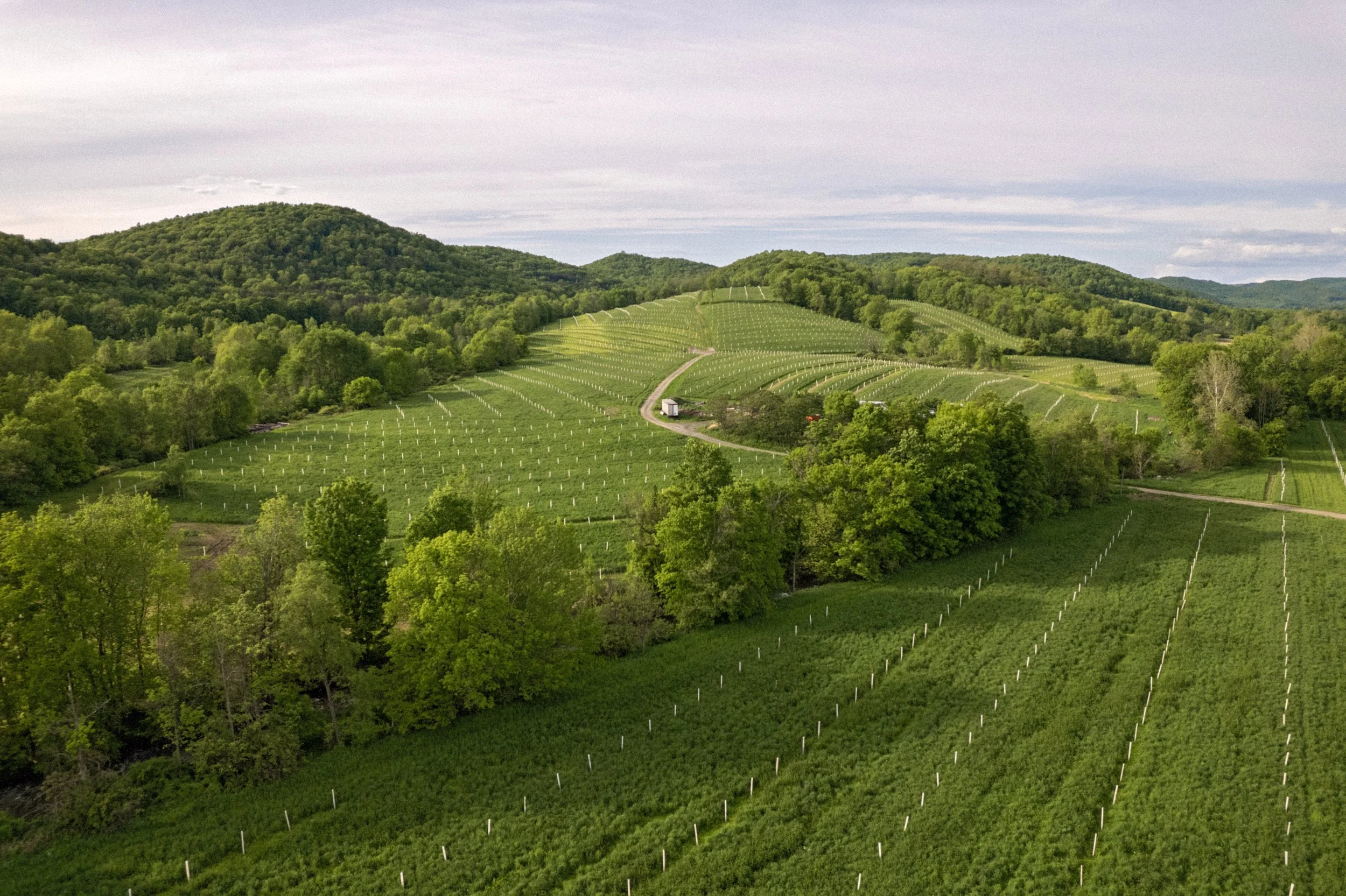
Breadtree farms on 800 acres in the Upper Hudson Valley (NY) and Southwest Vermont, where they steward 20,000+ food-producing trees and shrubs — including chestnut, hickory, oak, seaberry, apple, pear, mulberry, and persimmon — in orchards grazed by sheep and cattle. The practice of raising food crops, trees, and animals together has a long history in many cultures, and (today) is often called agroforestry.
Russell believes chestnut trees — an ancient staple food across the temperate world — play an integral role in recreating an agriculture of place; he has dedicated the past 8 years to creating a viable business centered on the growth of a regional industry for this tree crop. Outside of Breadtree, Russell has consulted internationally with multi-billion dollar food supply systems, advised the European Commission on regenerative agriculture policy, and worked with leading regenerative agriculture organizations to impact thousands of acres.
Transcript
Chestnuts and Food For the Future
Date: January 29, 2026
Duration: 1:05:16
Russell Wallack: All of our trees we plant are seedlings, which means today we're at about 16,500 chestnuts specifically, about 20,000 trees total, and all of those are genetically unique individuals. From an agricultural economics perspective, everything I can model suggests that the planting of the chestnuts in the silvopasture system has way more economic upside than the grazing operation does. The people and what is held in their bodies and minds is the project. We might have chosen the wrong trees to plant—even if that's true, the fact that people have experience in this specific system now is a win.
Harry Greene: Russell, welcome to the Plant The Trees podcast. Let's start with the most important question: you manage tens of thousands of chestnut trees and you were once a professional Ultimate Frisbee player. To what extent do you think about a disc golf course within an agroforestry system?
Russell Wallack: I have at least one friend who has spent most of her life in some way involved in disc golf, who really wants to set a course through our trees. Actually, one of our full-time team members is a pretty avid disc golfer. At this point I'm not thinking about it that much, but I've already accepted that it's an inevitability that we will have a disc golf course.
Harry Greene: So jumping into more serious matters, for those that aren't familiar with chestnuts, how would you describe Breadtree and what you do?
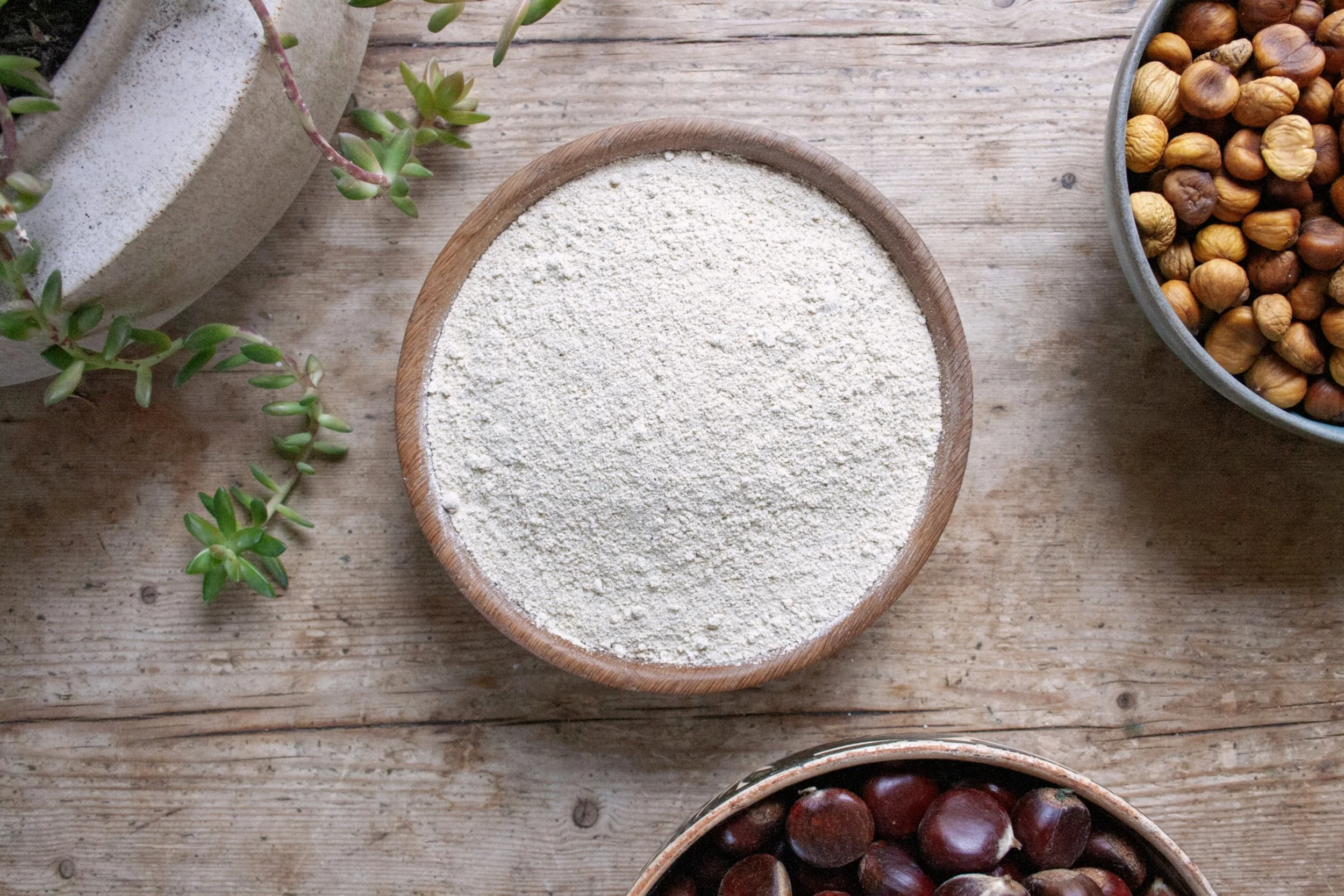
Russell Wallack: Well, we got started specifically with chestnuts. But I think there are two pretty founding principles of Breadtree. One is this interest and fascination with climatically or regionally appropriate staple tree crops. To make that clearer for people who aren't thinking about these things, there are a lot of wonderful trees in agriculture in the Northeast US today, but almost none of them, with the exception of maple syrup, play the role of what goes in your pantry. So flour, oil, vinegar, sugar—you have apple cider vinegar and maple syrup are the pantry staples that are produced in the Northeast today. Other than that, they're dessert crops. And the challenge with dessert crops is you can only plant dessert crops on so many acres and still have a market. I believe New York is the second-highest producing apple state, and it's got about 50,000 acres of production. I believe in New York there's about a million acres of degraded hayland alone, not accounting for active hayland or corn and soy. So 50,000 acres is basically nothing. If we want to integrate trees into landscapes that are currently growing hay, corn, and soy—not to eliminate them, but to ask where do trees integrate here—I believe we need to grow crops that fill pantry staple niches. Chestnuts are a gluten-free flour that grows on trees. And now what Breadtree is doing—the second principle was we need to show more people that this is a viable agricultural business. I tried to convince a lot of people that there was a viable agricultural business, and I realized there's only so much you can do verbally in convincing people if you don't show them that it actually works. So Breadtree was founded on the belief that there are staple tree crops in this region and that we need more people showing what a viable farming system looks like that includes them. We started with chestnuts, and today we're starting to invest more in other staple tree crops like oak and hickory.
Harry Greene: So beyond the syrup, you actually need the pancakes for breakfast, is what you're saying.
Russell Wallack: Exactly. And to make pancakes, you need both flour and oil, neither of which today grow on trees all that much in the Northeast.
Harry Greene: And to some extent, you might have chickens. In the future you'll have eggs, you can feed the B-grade chestnuts to pigs and have bacon, and then you'll move towards this farm that's producing a complete breakfast.
Russell Wallack: That's the idea. We will at some point rebrand to Breakfast Farm. I don't know if all of that will occur on the same farm, but what we are trying to contribute to is an agricultural system in which, across our diverse Northeast landscapes, all of those functions can exist. I think for us, a really big design question is what happens at the farm scale, what happens at the sub-watershed scale, and what happens at the greater watershed scale here in the Northeast, in our very heterogeneous landscape, which is quite different than what agriculture looks like in the Midwest.
Harry Greene: We have hills instead of flat, well-drained soils. New York is pretty diverse. Just a follow-up question there for those that are familiar with chestnuts, and for the chestnut nerds, how would you differentiate Breadtree and the specificities of what you're up to?
Russell Wallack: I think to differentiate from Propagate, for example—my understanding of the founding of Propagate was around software and service, a software-enabled service of helping other farmers plant trees. You are also a farmer yourself, so I don't mean to say as individuals that's not—but your business model was a service offering. I think fundamentally, our business model is: can we start a single farm business that produces food and works in this place? And I think we need both of those things. I think how I see it is your role is a greater role in expansion of these systems and of tree plantings. Our role—what we learn every day is just how much we have to build a team of people who want to dedicate so much life force and careers towards this work. Because there just aren't enough people in this country whose career has been specifically focused on this project, and we need that embodied farm wisdom lineage to expand for this to be a more vital industry than it is today. As you know, when we both got started there was about 4,000 acres of chestnuts in the whole US. And it's amazing what people have done to make that happen, and we need about 100 times the human body of wisdom to make this a more vital industry beyond the folks who have grown those first 4,000 acres.
Harry Greene: You can go to Texas A&M and get a degree in pecan agronomy or dive into apples, but we need at least to start off 20 or 30 more Miller and Staley families.
Russell Wallack: So in a way, we're trying to do in the mid-Hudson Valley, New York, what the Millers and the Staleys are doing in Ohio. We're trying to be another hub of this next lineage of chestnut production and farming specific to our region.
Harry Greene: So we'll have a lot of folks listening to the podcast that may be semi-familiar with chestnuts. The first question we often get, because people understand this used to be a crop—just to get this out of the way, how do you think about American chestnuts, and how can we segue into Chinese chestnuts?
Russell Wallack: I think of them as two related but distinct projects. They are both operating within the same genus. The thing within a genus is that different species play different roles in different ecological niches. There are, I think it's under debate to some extent, but let's say about seven species of chestnuts in the world. The American chestnut, as far as I understand, is not the one that's best suited for an agricultural niche. If we think about the distinction between forest restoration and integrating trees into agricultural systems, particularly ones that are in an open-field context, there are very different economic forces that bear on the success of those two projects. Using American chestnuts in a fundamentally ecological restoration approach is a project in a forest context. In an open-field context, we need trees that are going to produce reliable nut loads, certain qualities of nuts that are going to be better suited for marketing, including nut size. But then we also need trees that are going to be earlier to production and ideally not all ending up 80 feet tall. Although with the heterogeneity we've seen in our seedlings, I expect that some of our trees probably will end up being 70 to 80 feet tall. I just think about it as filling two different ecological niches. To simplify it, a farm niche and a forest niche, and we're more focused on the work happening in the farm niche.
Harry Greene: Almost like a 100-foot tall black cherry in the woods versus a manageable Montmorency sour cherry in Michigan.
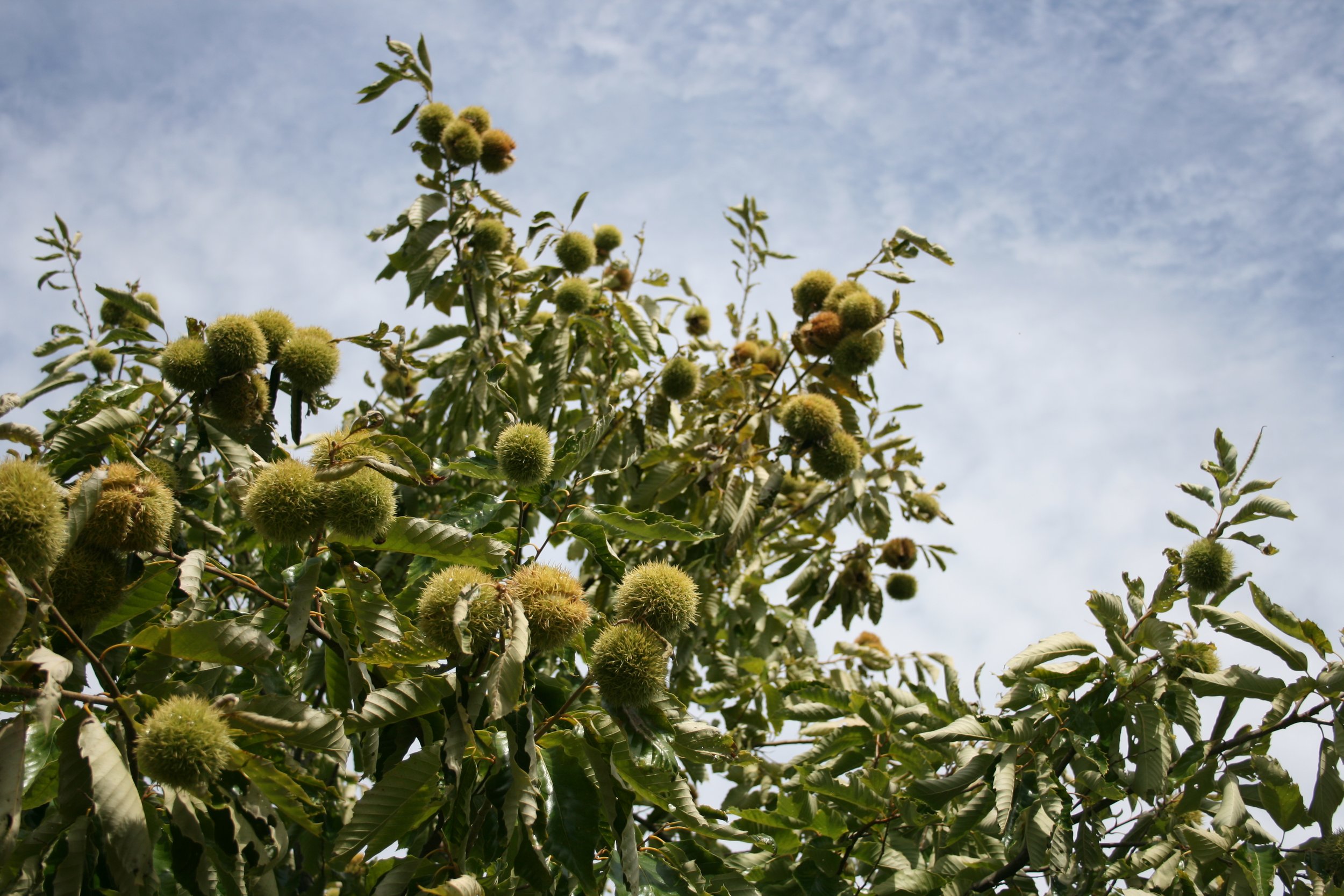
Russell Wallack: Exactly. The distinction I would make is that we are not going as far from the forest version. If you go from the wild cherry to the intensively managed clonal cherry orchard, we're not going as far on the spectrum towards the farm niche. All of our trees we plant are seedlings, which means today we're at about 16,500 chestnuts specifically, about 20,000 trees total, and all of those are genetically unique individuals. There isn't a clone among them. So we still have quite a bit of genetic diversity within our plantings. Even a planting that is 2,000 chestnuts is 2,000 totally distinct chestnuts that are predominantly Castanea mollissima, the Chinese chestnut, but have also complex hybridity within them. Some of them are second or third generation progeny of multiple species being crossed. So it really is a giant orchard of many different mutts, not a single clone.
Harry Greene: And maybe 40 years from now we'll have a handful of more true-to-type seedlings, or maybe even clones, and maybe we'll want to plant those. Maybe they'll be for folks that aren't us. But if we think about almost wild Chinese chestnuts, and the extent to which they have or haven't been bred, how would you describe the state of chestnuts now, relative to, say, 50-plus years ago, and then where we would like to go with genetics moving into the future?
Russell Wallack: I don't consider myself anywhere close to an expert geneticist or plant breeder. I defer to a handful of other folks on our team, and then Yellow Bud Farm Nursery is who we source a lot of our genetics from. So I can't really speak to the nitty-gritty details on that. What I will say—part of what we're doing is every tree that we're planting is geolocated in a database on a map and is tagged by its parentage. So it's the mother tree that that nut fell off of. What that does is place us in this lineage. Most of the genetics we're planting are coming either from the Route 9 cooperative, so the Miller family's operations, or coming from Bob Staley at Wintergreen Farm—multi-decade operations in Ohio, both of which have not only been observing the performance of individual trees but have been observing the performance of the children of the higher-performing mother trees. This idea of progeny testing, so saying 'Harry, you're a great athlete, you can run a sub-five-minute mile even today,' but there is no guarantee that if you have a child, that child will be the same athlete that you are.
Harry Greene: Go for it. I mean, you got to choose who you're creating offspring with, and you have to choose which chestnuts you want to plant in the future.
Russell Wallack: 100%. When I got started, I kind of thought 'Oh, if I just go find a chestnut tree in the Northeast that's 70 years old and it's still producing nuts, that's good enough for me. I can just plant seedlings.' But the truth is we have to plant seed of trees who have shown that they produce successful offspring. With a lot of help from Jesse Markson and Eric Cornell at Yellow Bud Farm, we've started planting—basically the last 80% of our orchard, which is most of what's been planted in the past three years—from progeny-tested parentage. Parentage that has been shown to create higher-performing offspring. Now we also have that parentage tracked so that as those trees start producing nuts and perform, not only can we share that information with the folks who we got the genetics from, but we can also learn in our context—is that genetic potential expressing in the same way in the New York context, in our organic silvopasture management system, which is not the same management system that the parents of these trees were raised in?
Harry Greene: Everyone does this with squash and tomatoes and wheat, but we're looking at maybe a 20-year feedback loop. I've heard Greg say that how a tree performs between years 11 and 20 is a pretty good indication of how it's going to perform in years 20 to 30. You and I are going to have a lot more gray hair before we have multiple feedback loops. But we can start with those tested varieties. Say I have 30 different seedling varieties on my farm, and I'm in Ithaca, New York—that's going to be different from the Finger Lakes Nut Farm, different from the Hudson Valley. We're going to see over the next 20-plus years how all of these varieties do.
Russell Wallack: And there's—one of the challenges we're facing is we intentionally overplanted density, and already this year, six years after planting, we're going to need to start thinning. Some of our trees that we planted six years ago are 20-plus feet tall and have a 17-foot spread, and we don't actually have enough information on these trees to select who gets to stay. If I have six beautiful trees in a row, there just isn't enough production data for me to know. But what I am observing, for example, is when leafhopper comes through after the first cut on the hay, they're side by side on trees, there is different response to the leafhopper. Some trees, all of their new growth is curling and having some yellowing, and they push through that, but their neighbor maybe is showing almost no damage. Then the Japanese beetle shows up, and we see more predation on some trees from Japanese beetle than others. So we do start to have data points, even at year six in terms of overall vigor. We are starting to get into our secondary thickening on our bark, which is a new term that I just learned—I love it. But that means we're getting fissures or cracks in the bark. So we will start to see blight showing up, and we'll get to see who's taking more or less pressure from chestnut blight. I think for us, in the early days, it'll actually be more about selection for pest resistance and tree health, especially amongst neighbors. Then over years 11 to 20, nut quality and production will drive the further selection. And I think one thing that we're looking to add into this overall selection—back to your point of what's happened in the past 50 years—my understanding is a lot of the selection has been on tree health, overall yield, and then nut quality, where nut quality is being selected for a fresh market. So selling whole chestnuts that consumers are either going to roast or braise or cook in some way. The one thing that has barely been selected for, as far as I can tell in the US, is nuts that are better for flour production. Some of the growers we've talked to even have cloned trees that probably would have been really good flour trees, meaning they produce a lot of mast, a lot of chestnut weight, but maybe those nuts dry out faster in cold storage or those nuts are uniformly smaller. For us, it's actually quite important that we start to shift the genetic lens to include nuts that might be really high-production trees that are going to be better suited for flour production. Because I believe that quite quickly we're going to saturate the entire fresh nut market here in the US. It's possible we've already planted enough trees in the past 10 years to do that. And I really think the higher potential here is building a gluten-free flour market around chestnuts. The gluten-free flour market today is about $9 billion in the US. The last time I checked the fresh chestnut market, you probably know better than me, but it's $50 million or something like that.
Harry Greene: I was just thinking I picked up and ate one of the colossal varieties of chestnut and just spat it out because it tasted like an acorn. Nothing against acorns, but it just was so full of tannins, and it was not worth eating in that moment. However, like you're saying, varieties like Colossal or others perhaps with higher tannins could be really good for flour via some of their other properties.
Russell Wallack: I don't know specifically about Colossal, but yes, all of that. There are multiple lenses with which we have to be doing genetic selection and thinking about what is the market we're trying to build over the next 50 years, and how are humans going to continue to relate to these trees? Despite not being an expert, I think I can say this: it's very important in breeding not to hold a binary of 'this is a good tree and this is a bad tree.' It's 'in what context is this tree the right tree, or is this lineage of trees the right lineage of trees?' And market and economic models are a part of that context, as much as the ecology is. There isn't really any way to get around that in farming.
Harry Greene: I want to dive into chestnut culture in a second, but I want to jump back to something we were touching on before—a question that comes up so often: chestnut spacing. We're at 20 by 20 feet between trees, such that we can hay between them with a swather. I believe you are at 40 by something slightly less than 20. We're looking at breeding chestnuts and having a production orchard at the same time. If we can have a few years of production after break-even and before we thin, that seems like an optimal scenario, because you still get to select your best chestnuts, and you have more chestnuts to sell earlier to break even and drive profit. How do you think about spacing now after you've planted a few hundred acres of chestnuts?
Russell Wallack: Again, I do want to hold the caveat of context. We started at 40 by 13, specifically because our first planting is a silvopasture planting integrated with a 100% grass-fed beef herd. With beef, you can't have inclusive paddocks, meaning when you set your fencing in a rotational beef system, you cannot include the trees in their tubes for at least the first five years. So we run a single strand of line down the row, a 20-foot alley. With that context, it's too much fencing work for the amount of grazing you're getting as the grazer. So we thought if we go 40 feet wide and we have a 2,000-foot alley, we're getting a two-acre paddock out of that. I wouldn't say that has ultimately ended up being the perfect width. I think—I was just talking with our grazing partners last week—if we were to plant again with them in that context, it would probably be at least 60-foot alleys and then less densely in-row. What we might even do is just a long row on the biggest ridge at the farm and then a 500-foot alley, so it's almost like you just have a tree row that isn't in any way changing the shape of your paddocks or your fencing. Now we, on our own farms, are grazing with sheep, and we are doing inclusive paddocks. I think in retrospect, probably if I knew we were going to move towards a sheep grazing operation, we would have done more 20-foot alley spacing earlier. Whereas a lot of our plantings are in 40-foot alleys and then shifting to in-row. We have our wide rows, and then we have trees very densely in-row. We started at 13. The idea there was we're triple density. So if two-thirds of the trees are culled, we end up basically with a 40 by 40-foot grid. And so the outcome there is the same outcome as a 20 by 20 grid. It's just the route to get there is leaning more towards grazing and less towards orchard production. Again, that started in a context in which I was quite cash poor and was trying to do a revenue-share lease and make it work with a grazing partner, and basically trying to keep my land costs low and be a good partner. If someone gave me $10 million today to go plant as many chestnuts as I could, and I got to choose all of the context, I probably would move more towards a grid system, meaning uniform alley and in-row, and design it more for sheep than I would for cattle. The other reason for the really dense spacing was basically I didn't have that much confidence in my ability to raise a tree well. And in the past six years, we've made 500 mistakes. But even despite that, our six-year-old planting is quite vigorous in a beyond-organic context, where our only vegetation management is mowing and mulching, and we're not irrigating at all. And our newer plantings are even more vigorous. They're like a season and a half ahead of our six-year-old planting. Trees in their third leaf are 12 to 14 feet tall, and have six lateral branches probably at a six-foot spread, which will be a 14-foot spread by the end of next growing season.
Harry Greene: What would you attribute that to? I hope it's not anomalous, and you've just—you've learned from so many mistakes. I would guess you've been able to select soil type intentionally.
Russell Wallack: I don't totally know. This is a very present question for us right now—what has changed? I think, for one, more experienced planters. We've moved from an amazing community of weekend warriors who were working five days at a veg farm and then showing up to work two days on a weekend to plant trees and had never planted chestnuts before, to a full-time salaried team for the past two years. Even the folks who are working part-time seasonally with us are folks who've been planting trees with us off and on for four years now. So we're definitely just doing a better job of planting bare-root trees. And this, for me, this is a huge bias in how I think about this work—I'm not a huge fan of mechanical tree planters. I'm quite skeptical that for certain stock it's going to produce the best outcomes. I think if you select your tree planting stock for a mechanical tree planter and are controlling other variables, it can obviously be quite successful, because people have done it successfully, especially with fibrous root trees and other species. And especially if you're irrigating, I think that can really make a big difference. For us, dry farming with bare-root trees that have quite a bit of variety in their root structures and the level of fibrous roots versus woody roots, I think an experienced planting team is really important. We also have switched to a different inoculation strategy. I did a literature review around chestnut specifically and found that there's quite a bit of evidence that native forest soil is a more effective inoculant, both in terms of take rate and diversity of take in terms of mycorrhizal species, than a lot of the commercial inoculants are. So we've moved to an approach in which we're basically breadcrumbing the tree roots of all trees that we haven't raised in our own nursery with native forest soils from essentially red oak forest that would have had chestnuts in them. I think that is making a difference. We are trying to figure out what the best way is to actually analyze that. So we're probably going to dig up a handful of trees. I have some emails out about whether it's eDNA or microscopy to look at those root systems and evaluate how different the outcomes have been there. But I mean, there's data that the right mycorrhizal relationships on Chinese chestnuts can increase phosphorus uptake by 70%. So in a context where we're not adding a lot of macros, having the right mycorrhizal relationships, I think is making a huge difference. We also just had better mowing, so less vole predation, more and better over-winter management. We're keeping things healthier in their tree tubes. At our first planting, we trialed three different tree protection strategies—welded wire cages, Tree Pro shelters, and Plantra shelters—and we're firmly on team Plantra. There's just a lot more uniformity in everything we've planted since that first planting as well. So it's obviously multi-variable. It's the soil conditions, it's what was growing there before, it's the level of glyphosate that was used on that site before, the health of the soil microbiome. I just believe it's all of that. But to get back to the question I was answering, basically what that's telling us is planting 13 feet in-row is just too dense for our management, because that gap is probably going to be filled by the end of the fifth season, and we just won't have enough data before we start culling. So we're moving to kind of minimum 16-foot spacing in-row, depending on alley spacing and the overall density we're trying to achieve. I think what's important there is we might raise all of these trees perfectly well, and because we're planting seedlings, we still would want to cull some of them. For example, planting at 40 by 40, even if we have 100% survival and these trees are amazingly vigorous, we're going to end up with trees that we still wouldn't want to keep in the orchard from a production standpoint. That's my only skepticism with fully shifting to a 20 by 20 model—is that still giving us enough selection? I think it is in terms of the density. You're still planting 100 trees per acre and thinning over time towards 30 to 40 trees, and probably closer to 30 trees an acre. So I think that's still enough selection. But I think that's one of the things we're going to just have to keep observing over the next 30 years—what is that right density to ensure that you're ending up with the genetic potential that you want?
Harry Greene: So you want a really good playbook, and that still doesn't absolve you from having just more shots on goal. Super-quick question on silvopasture: you mentioned cattle and sheep. Are you using the electronet fencing or more of the polywire? And if it's the polywire, are you attaching that to the tree tubes? We've seen a lot of that, and it looks really good.
Russell Wallack: In the cattle context, it's polywire. In the sheep context, it's electronet. We have not done what Austin at Trees for Grazers has been popularizing of running the wire around the tree tube. I think I've also seen video from the Savanna Institute doing that. This is just running the stakes, the fencing stakes, along the perimeter of the rows, so the trees are excluded from that alley. That has worked pretty well. I'd say sub-10% browse on trees in a 20-acre block, if we're excluding all the trees. When there's been lower feed value due to drought or just change in the pasture mix over time, and our grazing partners have included the trees in a larger paddock, that has not resulted in great outcomes. Not catastrophic outcomes, but just way more browse. Also things like the calves start playing with the tubes and knock them a bit, and then the trees are tilted a little, and the mothers start browsing the lower branches. So I really would not advocate for trees under, I don't know, four to six-inch DBH being inclusively grazed in a cattle context. So far we're seeing pretty good results with sheep inclusively grazing, meaning the netting is actually running around the tree row. But we're early days. We're like six weeks into having our own sheep herd on site, so I would not make any guarantees to anyone else.
Harry Greene: If only it were easier to have massive flocks of geese and people ate more goose. Because if you think about waterfowl like geese specifically, they're vegetarians, they eat grass, and they turn grass into meat. You can supplement them with grain. They're annoying, and I was super jazzed on geese for a while, and then I raised a few geese to understand the process. Slaughtering them was fine. Ripping out the pin feathers and the down is incredibly difficult. Back then there wasn't as much video and literature as I would have wanted. But basically, how they take the feathers off of geese is by dipping them in wax and basically waxing the goose. So I feel like it's so much easier if we could have a sheep with a bill that wouldn't eat the trees as well. That would be phenomenal. I don't know, like a giant platypus or something like that.
Russell Wallack: A goose-sheep cross? I will say, and I'm curious what your experience is on this. One evolution of our business is we have started to take on service contracts in a similar way to what Propagate has done. I think the distinction is—I'm not actually clear on the structure of your contracts—but our contracts are a minimum five-year term, so it's really an establishment and management contract. One of the things that's exposed me to is, our clientele, frankly, are not, for the most part, professional farmers. They're non-farming landowners or folks interested in getting into farming who have significant means. And it's introduced me to a conversation—I've been surprised by this. I think a lot of folks thinking about investing in agriculture and agroforestry basically are overestimating the viability of animal systems right now, in the type of farming that we're talking about.
Harry Greene: Economic viability or logistical, or both?
Russell Wallack: I'm referring more to economic viability right now. We're starting our own sheep herd, and we're knowingly going to lose money for the foreseeable future on it. We're doing that because we want to be bringing that body of knowledge into our business, and we're cycling fertility and decreasing mowing—they're not coming close to replacing mowing, but decreasing the amount of biomass that is processed through a flail mower. So I see that as probably a half-decade investment we're going to make of 'if we get to a larger herd, is there a viability here at that scale?' But I think it's actually one of the interesting aspects of the silvopasture conversation. So much more of the skepticism is about the tree planting when, if you ask any grazer in the Northeast right now about how easy it is to run a grazing business, I actually think the tree planting part and establishing trees might be the easiest part of silvopasture in a way. I think the financing of the tree planting is a very challenging part, especially for most farmers. But from an agricultural economics perspective, everything I can model suggests that the planting of the chestnuts in the silvopasture system has way more economic upside than the grazing operation does. And that's not me saying 'so we shouldn't graze.' I'm just—it's something that I've been really fascinated by in our now six years of operation is starting to understand that. Because in the very naive way that most of us come to agriculture, I just assumed, yeah, cows eat grass, and that's a part of farming, and it's always going to be a part of farming, and it just works. And what I'm learning is it only works at certain scales and in certain business models. It's not just a turnkey solution to having a viable ag business.
Harry Greene: We see the same thing in Argentina, where the trees, if you look at the internal rate of return, have a much higher return. But cattle are such an ingrained part of the culture for good reason, because they're turning things that we can't eat into protein and fat and things that we can eat that sustain us. I can't go pull a log of black locust out of the wood, throw it on the grill—I can throw it under the grill, but not on top of the grill. So we really want both of those things. The cultural aspect, I feel like, is something that you guys have excelled at 100%, because bringing people into these systems to manage more horticulturally intensive crops compared to fully mechanized grain systems is just a necessity. And you've had tree planting days and you have a really solid team. Could you tell us a little bit about your journey in building Breadtree from a human perspective?
Russell Wallack: Sure. I mean, I guess I'll start just by saying, because I think this is one of the traps of the one-on-one podcast format, I have not built Breadtree. We have built Breadtree. And I'm here as a representative of eight other people working full-time on this business, and I have lost count at this point, but over 200 people who have in some way participated in the growth of our business, even if that's for two hours. One of the total switch flips for me was, I think, in my second year, which at this point it was just me, and then friends who had—I'd pay a pretty good hourly rate to show up on a weekend and do some work, or my wife would come help me out and very kindly wouldn't charge me for her time. And I realized at some point that when you are—as we said, there were about 4,000 acres of production in existing industry. For it to get to the place that I believe is possible, that I think you believe is possible, we know it just has to grow. And in a way, I just realized that the people coming from Brooklyn, driving four hours, camping out for the weekend and working for 16 hours on the weekend were just as relevant of a convert in growing this system, in believing in this system, and seeing the power of working on landscapes in this way as any farmer who I walk into their house and try and convince them that they should plant chestnut trees. Which is something I've kind of stopped doing. I try and let the work speak for itself. I remember I had a pruning day where I was one of three people who had ever pruned a tree, and we had 15 people out there. I remember saying to these people in a circle, 'Don't show up here with fear that because you haven't pruned, you're going to hurt the trees. Show up knowing that you pruning the tree is a part of this project. You getting your first experience pruning trees and starting to have a relationship with these beings who we're caring for so that they can care for us—that is the project as much as what yield is at year five.' It supplants what yield is at year five, because you need something to sell to continue to have a project, or otherwise in some way you'll lose tenure on your land or whatever. But just, I had this moment of realizing, 'Oh, that is as much the project as the financial viability is.' And I think that for me, that moment just taught me something that I really believe—I know we share this belief—that we all need to be working in spreadsheets more in farming. You need to test assumptions. You need to say, 'Okay, if this thing I believe is true turns out not to be true, and it's as wrong as I could possibly imagine, how little money will I make? Or how will this business cease to function or not? How much will that stress things?' The bear case. I think that is true. I firmly believe in that. I think it is a superpower that our business has, that we can work in a spreadsheet. What I think is really hard to model in a spreadsheet is human interaction and what happens when more people engage in the story of the work you're doing, have hand-to-hand and face-to-face contact, digging in the soil and planting a tree. The way that person relates to the food that we sell, or the way that person speaks about our business, which is a social organization, a community in a way—the way they speak about that to their friends who have never heard of chestnuts or have never heard of agroforestry—is impossible to model. It is truly a complex system. You cannot predict what that value will be. So I think what I just started realizing is we, as people who work in complex systems and living systems, we have to see where there are controlled variables and make informed decisions, basically at a best and worst case level. But we also have to make decisions that are investing in emergent potential. And I don't mean that in the hand-wavy sense—that is literally the scientific term. You and I having this conversation has emergent potential, where neither of us know what this conversation will do for someone when they listen to your podcast. For some people, it might be they say, 'I never want to buy flour or chestnuts from those guys, he seems like a douche.' For other people, it'll be 'Wow, I want to spend the rest of my life investing in this work.' But the fact is, we cannot predict what that outcome will be.
Harry Greene: But we have to throw enough boomerangs in the right direction and see what comes back.
Russell Wallack: And so I think that is pretty deep in Breadtree's genetics, if you will, as an organization. The other thing that I think—and Noah, my business partner, I think really has affirmed this, as well as Bug, our third partner in the office work, not the field work. Both of them, I think all of us, kind of take turns reminding each other about this, but the agriculture we are practicing has never been practiced at the scale that we are practicing it. Growing chestnuts organically before an organic certification existed in native land management systems did. But truly in the economic context we are practicing in, using the tools that we use and using the agronomic systems that we're using, has never been done at the scale that we're doing it in the place we're doing it. So there are people to learn a lot of different things from. There is no one who can give us a roadmap. And one of the things that that has reinforced for me is our people are the greatest form of intellectual capital that we have. There's no document I can write or we can write together that's actually going to be an artifact that captures the way Jasper is experiencing an orchard right now while he's mowing it for the first time this year and seeing what happens when we wait to mow until July after two passes of grazing in that orchard context. No one has ever had that experience before. And so what that means to me is investing in our team, having salaries, having benefits, having paid time off, policies that make this all feel sustainable for all of us, that make us all think, 'I actually could make this my career' is probably the most important investment we can make. And it's not a dollars and cents thing. There's no way I can even measure how much value will be lost if one of us decides, 'Yeah, this isn't it for me.' The organism will change shape and someone else will come in and it'll work. But when you are doing something at the scale we're doing it in the specific way we're doing it—I'm not trying to own chestnuts or anything, it's just the way we are doing it—there is no guidebook. The people become the most important part of it, in my opinion. And so every decision we make, to me, it's like 'Do we need to buy a piece of equipment to make this more sustainable? Are we creating risk to our team's health by leaning on this way of doing something?'
Harry Greene: Increasing the amount of stoke over time with appropriate equipment?
Russell Wallack: Exactly. So, sorry for the long-winded answer, but I think those are the two ways that culture, to me, is showing up. How do we bring people to this, knowing that there's no way for us to guess at what might emerge from bringing people to this? And also, how do we care for the people who come to this work, knowing that the people and what is held in their bodies and minds kind of is the project? We might have chosen the wrong trees to plant—even if that's true, the fact that people have experience in this specific system now is a win. That is a better outcome than had we not tried.
Harry Greene: So you're inoculating your trees with ectomycorrhizae, and inoculating newcomers to agriculture from Williamsburg, from Brooklyn, and creating this human ecosystem that goes back and makes the forest work. Or the anthro-forest, the anthropocentric reforestation, agroforestry system.
Russell Wallack: And with that, I'll say, built into that answer is not 'so we've figured it all out, and now we can stop.' I honestly think we have more to learn than what we have learned by a lot, probably by 100x. And so building an organization that wants to learn and stewarding our organization in that we keep learning and we keep asking questions, I think is really important to being able to evolve a system.
Harry Greene: Human resiliency, redundancy. What comes to mind is that we're having this very people-focused discussion. And you can say that an interest in people and an interest in things are not opposites, but people tend to group into sometimes one of those two buckets. So you could be interested in both. But say, machinists are much more interested in things—engineers, bricklayers—and then an interest in people you'll see in nurses and teachers, human resources, maybe even marketing. And I was thinking about this the other day. I am not necessarily drawn to machines. I'm very much drawn to people. I love having concerts and get-togethers and seeing people's eyes light up. Would you put yourself almost at the bridge of those two things, because you need machinery? Do you see machinery as a tool to increase human interaction?
Russell Wallack: Perhaps. For one, I am not the person on our team who has the greatest proclivity for looking at complicated systems like machines and figuring out how they work. Jasper on our team really stewards our entire equipment fleet. Sam on our team does a lot of research on what's the next piece of equipment we need to buy to be able to achieve this outcome in our management system. Noah is thinking a lot about the processing facility and what equipment we need in there. I'm not a gearhead. I do think for me, it's less about the people and machine dichotomy, and more—where I tend to work is at the organization level, or, you know, in business speak, the 30,000-foot view, quote unquote. And I actually just—what I find is I'm really more concerned with 'what do we need to make this system function?' than I am at the individual human level or the machine level, if that makes sense. And I think part of my specific role in that is then pulling back and saying, 'What does the system need?' So what do the people need such that they can provide that service to the system? How do I help facilitate the mutualism that serves the greater system? How do I facilitate the rhizophagy, so that the trees can eat the bacteria from the microbiome? And what is it that the bacteria needs so that they're thriving enough that the rhizophagy can work, if that makes sense? So my role is neither stewarding just the tree or just the bacteria. It's hoping that I can create a healthy system for both.
Harry Greene: You need the gear heads to lower costs of production and make production happen, and make sure the voles don't eat the trees in the winter. And when equipment breaks, they jump in, fix it, and make the crop exist. And you need the human-centric people to drive that wedge between costs of production and sale price, which is marketing effectively. So you need those two categories, and you need the strategist, the whole-systems person, to pull it all together.
Russell Wallack: I do think also though, I guess I want to challenge that these are types of people and not learned personality traits, if that makes sense. I think what's maybe more unique to individuals is how they approach a challenge or a problem or a question. And I think what we've probably done in our society is basically try and categorize, 'Oh, you're a person who engages with the world in this way, thus you have to work with people. Or you're a person who engages with the world this way, thus you have to work with machines,' probably to a very detrimental extent, because as we know, every car mechanic also needs to engage with their customers and work with their colleagues and has a family of some sort or a community. It's not—no one is in a bubble away from people, and no one is just working with people and not also driving a car or not also taking care of their house. So I just wonder if it's more like we like to come up with categories, and so we put people in boxes, unless that's an ontological description of the world.
Harry Greene: We need more hybrids. With this being said, I'm thinking about a chestnut processing facility, and you've jumped into a whole lot of thought and research into chestnut processing. Could you tell us a bit about your ideal chestnut processing facility?
Russell Wallack: So I think what's interesting for us about the facility is that, again, because this is, especially in our region, such a young commercial system—there have been chestnut trees here for millennia, even post-blight people have continued to manage mostly Chinese trees. But no one has done that at a scale where they're bringing together 50 or 60 growers across a four-hour radius. Some of those folks are vegetable growers who have added 100 trees to their farm and don't want to really manage the trees past production. Some of those people are non-farming landowners who planted 10 acres of trees and want someone else to do everything. Some of those people are young farmers working an office job, waiting for the trees to start paying their bills. I think for me, because the facility that we're building is supposed to be a reduction of barrier to entry—it's a leg up to make other growers, help other growers be successful in our region—I think the best working of it is, again, less about the equipment. Specifically, that part, as intimidating as it is, is figured out. There have been chestnut processing facilities around the world for decades.
Harry Greene: We can buy Italian equipment and have the auger take the nuts out of the water, put them across the processing line—it's been done.
Russell Wallack: I mean, we visited basically in a two-week trip half of all of Italy's processing capacity. We visited multiple 10 to 20 million pound facilities. We're trying to build up basically a half to one million pound facility in New York, and we're going to be in this successional process of getting there over the next 10 to 15 years. We're going to build this first phase and then expand our processing capacity over the next decade. So to me, the more important aspect of the ideal working is actually: what are the communication strategies we need with other growers? What's the trucking and fan capacity we need to be able to aggregate from other growers effectively to get nuts to our facility? Do we have to do that daily, so that we're taking fresh nuts and getting them to the facility within 24 hours and putting them through a hot water bath for weevil pressure? Or do we need to create a hub-and-spoke model where we finance hot water baths every 50 miles within this hub-and-spoke system, those nuts then get cold-stored, and then come to our facility for the last phases of processing? So to me, the greater question of what's ideal that we're designing is the human systems and the logistics system that allows a facility of this nature to work. What's interesting about that, and then I just want to be clear about is—we don't actually need to do that. Our business is probably going to produce between half and three-quarters of all of the chestnuts that flow through this facility, just in terms of the acreage we've planted, and frankly, how the acreage that we've planted is doing compared to the acreage that many others have planted. What we're seeing is not all five-year-old orchards are equal, and some of the lesser-managed acreage in the region is not doing as well. So we could just build a facility that serves us. What we believe is that if we do that, we are limiting the potential for growth of this agricultural system in this place by not serving a broader constituency. We're showing: here's how it works if you're a 10-acre beginning farmer, here's how it works if you're a grazer integrating chestnuts into your system, here's how it works if you're a vegetable grower alley-cropping between chestnuts, here's how it works if you're a small grain farmer. So for us, the ideal thing is that we are providing a little bit of a catch-all that supports people to do this work in the way that meets how their life works. I think that would be a really important outcome, or an ideal outcome for us.
Harry Greene: So the 7,500-square-foot building is just the metal and the infrastructure and the insulation and the refrigeration that makes this whole system work of different people and different landscapes across Washington County and beyond.
Russell Wallack: Exactly.
Harry Greene: Breadtree also plants and processes other tree species. Are there species that are top of mind for you? You're really psyched about that you want to work into this whole agroforest food ecosystem?
Russell Wallack: I always try and be really clear—we're making choices about what we focus on. That is not a statement about what anyone who's thinking about planting trees should focus on. It's what we think we want to spend our life energy on. So specifically how that relates to our relationship with you is we're not as focused on black locust as you. That doesn't mean we don't think black locust should be planted, or that it has a role in specific systems. We really see ourselves as focused on tree crop agroforestry. So trees that are producing food agroforestry, and specifically more focused on what we think of as perennial pantry staples. For us, that's a handful of trees. Chestnuts as one of the gluten-free flours that grows on trees. Butternut or yellow bud hickory and hybrid hickory—less as a pecan, we are interested in hybrids that are more like a northern climate pecan for fresh eating, but we're more focused on oil bush hickories. So hickory that have a thin shell that is a pressable nut that can be pressed for the oil that's in that nut that does not carry the tannins that are in that nut that give it the butternut hickory name, and it produces cartoonishly an olive oil analog, if you will. So a hickory tree that grows in closed canopy forests here in the Northeast that its fruit can be pressed for oil, a culinary oil. I recently got to try just dipping sourdough bread in roasted hickory oil. I mean, it was like sitting in an Italian restaurant and dipping it in a good olive oil. So hickory as an oil bush. We already have sugar bush on our property. That's the longest and most consistently operated agroforestry system in the northern United States, as well as Canada—is maple syrup production. Native people have been doing that for probably 10 millennia, at least. So we have that happening on our farm. That's less the focus of our work. It's actually co-managed with a man who leases land from us. And then the more recent investment we've been making, along with some partners at the Monarch Foundation and Metamorphosis Farm, is looking at oak breeding for acorn production, which really has three potential outcomes. The one we're most focused on, I'd say, is acorn flour. There are certain oak species that are also going to be pressable oil nuts. It seems like, from what we understand from the work others have done, that those will be distinct lineages of genetics. And then there are other folks focused on acorns as a part of a silvopastoral system, meaning you're feeding acorns to the animals. I think likely for pork. Flour is our focus, and we're doing two things there. One is we're planting white oak breeding orchards. This year we started planting 15 by 15 spacing, 41 different parents in clusters. What we'll do is, over the next 20 to 30 years, observe the performance of those trees, and specifically for precocity. So how quickly do they get to bearing age, how much are they producing, and how stable are those yields? Meaning, in a good year, how much are they producing, and how often are they having a good or average year? And then we're also doing that with red oaks. Those are distinct groups. So white oaks include white oak, bur oak, swamp white oak. And red oak is more Quercus rubra, the northern red oak, with some scarlet genetics and black oak genetics in there. And the distinction—which this is getting super nerdy, but I think it's really interesting—is that in the white oak group, there has been somewhat substantial breeding efforts in service to deer hunting populations who want to plant out white oak trees to attract deer to their property. In the red oak group, as far as I can tell, has been almost no contemporary breeding effort for acorn production. And even more interestingly, what I'm finding—so we have started doing a regional monitoring program where we're going and visiting open-planted oaks in cemeteries and arboretums and campuses. And what we're finding is, if you observe acorn production in open-grown contexts that are closer to how an orchard would be—full sunlight, grass is getting mowed, little competition—the masting numbers, the amount of acorns they're producing, the consistency with which they're producing them, and the young age at which they are producing them blows out of the water what is cited in academic literature in a forest context for red oaks. So frequently, if you even go to just a nursery's page, they'll say that red oak don't produce acorns until year 25. I just this past year easily harvested 100 pounds, and I would guess this tree produced 200 pounds, from a 15-year-old red oak tree. What that suggests to me is even just bringing these trees into a managed context and observing them, that alone—before we even start selecting them or doing controlled crosses or progeny testing—is going to probably identify a commercial population for acorn flour production using a native oak species. And then I think it starts to get really interesting in terms of the relationship with the conservation community and looking at oak regeneration, and how much can we push oak regeneration by selecting for higher masting species. Just to leave this lengthy discussion of tree pantry staples off, I observed a tree last year that the canopy was, frankly, just too large for me to harvest everything. So what I did is I put 120 square feet down on the ground, harvested every acorn within that, and I got 80 pounds from that 120 square feet. If you extrapolate that tree's production last year to an acre, you get 30,000 pounds of acorns. If you bring that down to 25%, which is what your acorn flour yields would be, on 30—you're getting basically four times the acorn flour production from an acre of that tree as you get from a wheat field. That alone, to me, suggests that there is immense genetic potential here that we're currently hugely undervaluing because we're not observing oaks in an orchard context. That's without contemporary genetic selection. You know, that's just building on the really important genetic selection that probably occurred under native land management for millennia, but not in a contemporary agricultural context.
Harry Greene: So oaks in prime ag soil, observed over a long period of time and selected for lower tannins, higher yields. And not just acorn-fed pork Jamon Iberico de bellota, but acorn flour that's great for brownies. What are your favorite uses for acorn flour?
Russell Wallack: The best dish I've had with acorn flour, which is also my favorite dish to make with chestnuts, is a polenta. So for Thanksgiving a couple years ago, I did two versions. I did a chestnut-acorn polenta, and I did a chestnut-acorn-blue corn polenta, and served that as basically almost like a corn pudding at Thanksgiving. And it just was so good. I mean, the only problem with it at Thanksgiving is it's so much heartier than what we're used to eating with the contemporary corn production that it just fills you up. It sticks to your gut, and you can't eat as much at the Thanksgiving table as you'd like. But it's just such a satiating food. And the combination of, when you bring the acorn and the chestnut together—the chestnut is, as you know, much more carbohydrate-dense, and the acorn has quite a bit more fat. And I think they're really complementary in that way.
Harry Greene: That sounds like a complex polenta or brownie or pancake potential. There's a book that I really love called 'Eating Acorns,' written by a lady who lives in Greece, and I've tried a bunch of recipes with both acorn and chestnut flour from that book and mixing them together, at least in cookies. Cookies are so easy. For those that are looking to learn more about Breadtree and what you do, where can they find you?
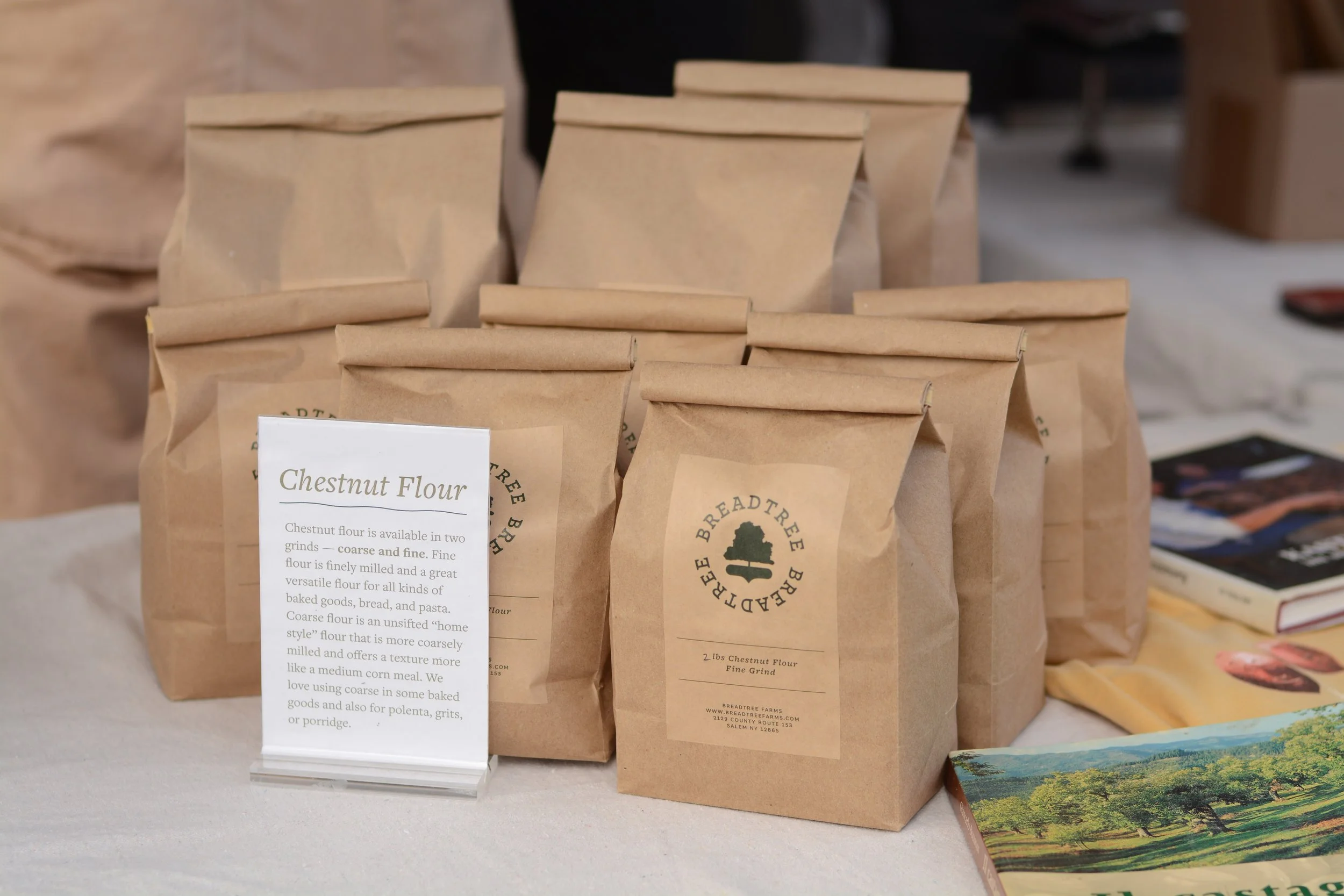
Russell Wallack: Sure. Breadtreefarms.com is the best place to go. We have a fairly active newsletter where we give a lot of really detailed updates on what we're up to, so I'd really encourage you to just subscribe there on the website. We have a semi-active Instagram that we try and keep quite informational as well. And really, if you want to support us, the best thing to support us at this point is buying food from us. I believe we have the most certified organic acres of any chestnut grower in the country. That's all coming into—we have about 90 acres that'll produce chestnuts this year, certified organic, that'll be for sale starting in late September, but you can pre-order now. We're also selling chestnut flour that we've actually purchased from Greg and Amy Miller in Ohio, and we have an extensive list of chestnut flour and fresh chestnut recipes on our website if you want to buy some flour and experiment along with us. And we've just started selling a very niche product that's really a 'make it for ourselves but sell it if anyone else wants it,' which is that in Italy there's a chestnut flour crepe that traditionally was just chestnut flour and water, and it's called necci. We have a double set of cast iron flat pans that you sandwich the necci between to cook it. We had a local blacksmith, Wicks Forge Smith, custom necci pans for us, because no one else was making them in the US. And you can now buy those on our website. So if I was going to make a suggestion, I would say go buy a bag of fine chestnut flour from us—not coarse if you want to make necci—and some necci pans, and then you can go participate in chestnut culture here in the US.
Harry Greene: That sounds phenomenal. Russell, thank you so much for hopping on the Plant The Trees podcast. I know we could talk for hours. Let's do it again sometime. Have a wonderful rest of your day.
Russell Wallack: Thanks, Harry. Pleasure to be here.