
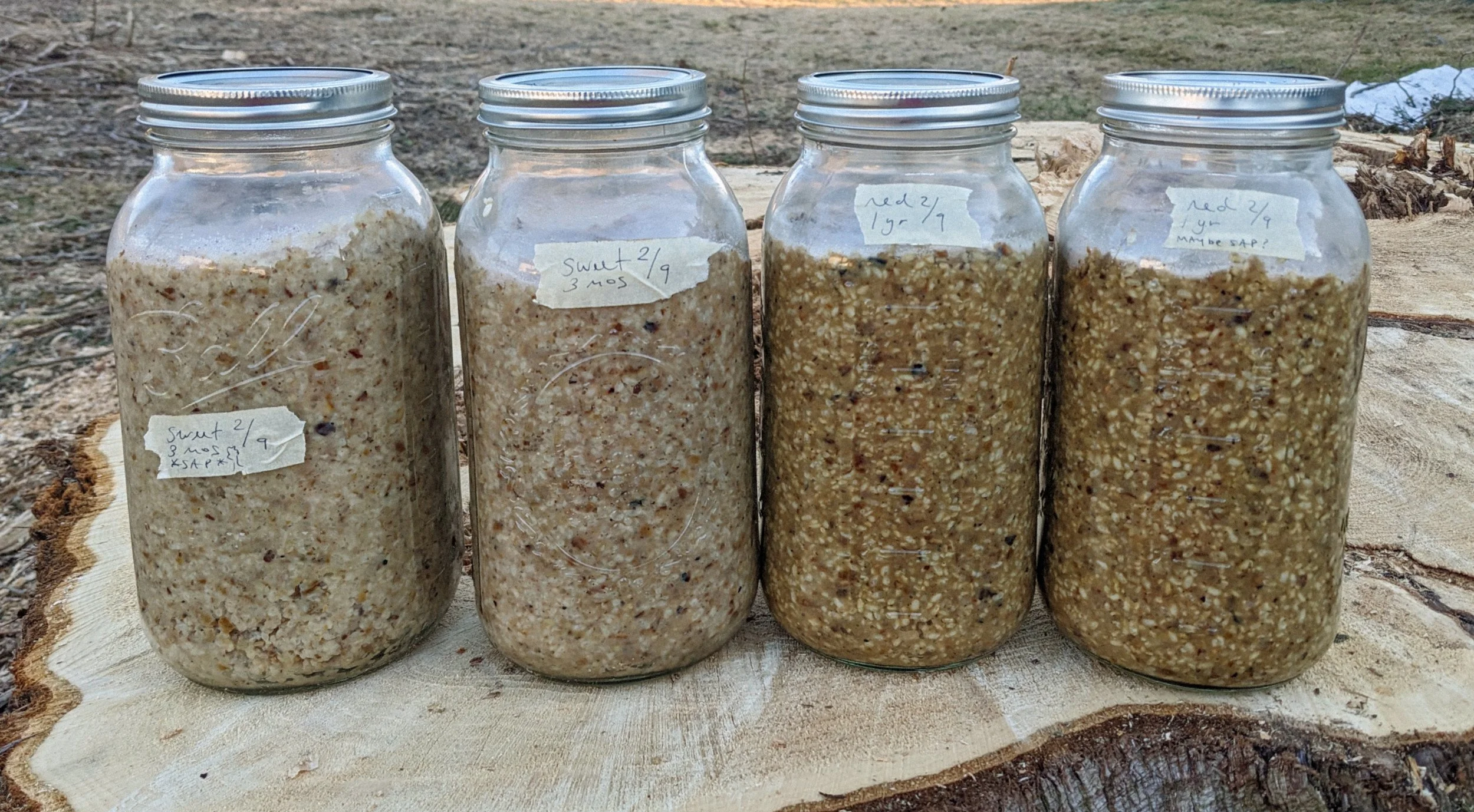
Chestnut Miso
Health Benefits of Miso:
Chestnut miso is a delicious, simple-to-make, and extremely healthy fermented food, which is a great option if you have been hanging onto some chestnuts for a little too long. Miso offers a number of impressive health benefits:
Koji (the miso culture) breaks down proteins into amino acids and peptides, the raw building blocks our bodies need to create energy.
A number of studies have demonstrated that regular consumption of miso reduces risk of many cancers, including gastric cancer and breast cancer.
After World War II, Japanese doctor Shinichiro Akizuki spent years caring for atomic bomb victims a few miles from ground zero; however, neither he nor his staff suffered the typical effects of radiation. He postulated that they were protected from the radiation because they drank miso soup every day. Akizuki’s theory was confirmed in 1972 when researchers determined that miso has dipicolonic acid, an alkaloid that combines with heavy metals and expels them from the body.
There have been a few well-documented studies noting that the consumption of miso mitigates the effects of radiation. A report published in Japan by Dr. Akihiro Ito described a study of mice that had been exposed to radiation and then fed a diet containing 10 percent miso (or fermented soy sauce for 13 months). They found that the female mice on the miso diet experienced a significant decrease in the frequency and number of liver tumors.
Despite miso’s high sodium content, studies show miso consumption does not raise blood pressure.
(Paraphrased from “Miso, Tempeh, Natto & Other Tasty Ferments” by Kirsten & Christopher Shockey).
General Steps to Make Chestnut Miso:
If you want to get a quick visual gist of the process, see this video on our IG.
Decide what kind of miso you want to make: The first thing to decide when making miso is, do you want to make a faster, sweeter miso (traditionally called a “white” miso), or a longer-fermented miso that will be saltier and more deeply umami (traditionally called a “red” miso). This is going to determine your ratios, which kind of koji you need (white or red) and your fermentation time. Otherwise, the process is the same regardless of which timeline and type of miso you choose.
Cook the chestnuts: Roast your chestnuts using whatever method you prefer. We have a recipe we like a lot that you can find here.
Weigh the chestnuts: Once you’ve shelled the roasted chestnuts, weigh the shelled, roasted kernels. Note that total weight (ideally in grams).
Weigh the koji: Based on the weight of chestnut kernels, calculate how much koji you need for the kind of miso you want to make. The ratio between the koji and chestnuts will be determined by your timeline and corresponding recipe — see below for those ratios. In a large prep bowl, weigh out the koji, and then cover it in cold water to let it soak for a few minutes.
Weigh the salt: Based on the combined weight of the chestnut kernels and the koji, calculate how much salt you need for the kind of miso you want to make. That ratio will be given in the corresponding recipe — see below. Weigh out the salt in a small prep bowl.
Decide what texture you want: It’s generally a good idea to physically break the chestnuts down into smaller pieces.
If you food process them dry, you’ll get a more crumbly texture.
If you want more of a creamy / paste consistency (more like South River Miso) add some water to the chestnuts in the food processor and pulse until they are processed into a paste.
If you want a totally smooth paste (more like many commercially available misos in the U.S.) with no rice-kernel mouthfeel, food process the koji until it’s powder. You can also add bit of water to make it into a slurry.
Mix everything together & add water to dial in consistency: Combine the chestnuts, koji, and salt in a large prep bowl, integrate well, and add cold water until it has a miso consistency. A good test of consistency is forming a ball with your hands — if it won’t hold together, add a little more water until it does. There is a range of tolerance here and (within reason) you get to decide how wet or dry you want your miso to be.
More texture options: If you want a really smooth paste, you can take the fully integrated mixture and food process it again, adding water as you see fit to cream the texture further.
Pack your vessel: Pack it into clean glass jars, packing as you go to eliminate air bubbles. You don’t need to go crazy preventing air pockets but it is important to pack the miso as you go and keep it to a reasonable minimum.
Close it up: Salt the top of the miso vigorously to discourage mold development, clean any obvious food residues off the lip of the jar, lid it and label it with the date of production and the target timeline for fermentation. Consider setting a calendar reminder to help you remember to check on it.
Aftercare: Ideal temperature range for miso fermentation is in the high 60s or low 70s F, but it’s not (in our experience) an exact science. Check on your miso a few times during fermentation. If you see visible mold forming on top, scoop it off and resalt the top.
Chestnut Miso Durations & Ratios:
Adapted from “Miso, Tempeh, Natto & Other Tasty Ferments” by Kirsten & Christopher Shockey.
Sweet “White” Miso (2-3 months)
1 part roasted chestnuts
3 parts “white” or sweet koji
6% of the total weight of chestnuts + koji
Mellow Miso Formula (6 months)
1 part roasted chestnuts
2 parts koji (either “white” or “red” works)
10% of the total weight of chestnuts + koji
Medium Miso Formula (12 months)
1 part roasted chestnuts
1 parts “red” koji
12% of the total weight of chestnuts + koji
Salty / Dark Miso Formula (24 months)
2 part roasted chestnuts
1 parts koji (either “white” or “red” works)
16 percent of the total weight of chestnuts + koji